

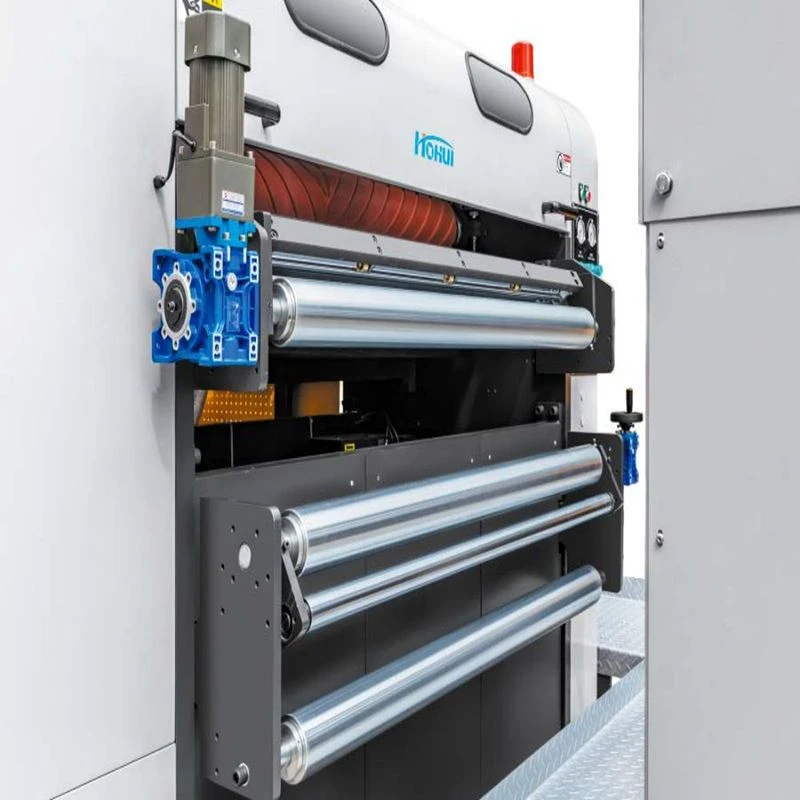
Product Introduction
Laminated Film Slitting and Rewinding Equipment converts wide laminated film rolls into finished rolls with controlled slit widths and winding conditions. It is used for multilayer packaging films, printed laminates, barrier structures and other flexible film materials. Configuration is selected from film structure, thickness, master-roll dimensions, finished widths, core size and rewind diameter.
Laminated Film Applications
Multilayer Films
Processes laminated film structures with different layer combinations, thicknesses and surface characteristics.
Flexible Packaging
Produces slit rolls for pouches, bags, wrapping materials and other flexible packaging processes.
Printed Laminates
Handles printed laminated webs where controlled web movement is required during slitting and rewinding.
Barrier Films
Suitable for laminated structures containing barrier layers and other functional film layers.
Material Compatibility
Film Structure
Machine settings are matched to layer construction, film stiffness, friction and stretch behavior.
Film Thickness
A typical processing range is 20–200 μm, depending on material construction and winding requirements.
Surface Properties
Film surface friction and coating characteristics are considered when selecting slitting and winding settings.
Slitting Requirements
Knife positions are arranged according to the required finished-roll widths and master-roll utilization.
Slitting method and knife settings are selected according to film thickness and laminate structure.
The cutting layout is determined by master-roll width, finished widths and required roll quantity.
Rewinding Control
Tension
The working tension range can be configured within approximately 20–300 N, according to material and roll dimensions.
Roll Hardness
Winding conditions are adjusted to obtain the required finished-roll density from the core to the outer diameter.
Core Size
Common core sizes are 3 in and 6 in, with other dimensions available according to the finished-roll specification.
Technical Parameters
|
Parameter |
Typical Range |
|
Maximum Web Width |
1,300–2,500 mm |
|
Film Thickness |
20–200 μm |
|
Maximum Slitting Speed |
Up to 400 m/min |
|
Finished Slit Width |
50–2,500 mm |
|
Maximum Rewind Diameter |
600–1,000 mm |
|
Core Diameter |
3 / 6 in |
|
Slitting Method |
Razor / Circular Knife |
|
Web Tension |
20–300 N |
|
Material Type |
Laminated / Multilayer Film |
Web Handling
Unwinding
The unwind section is selected according to master-roll width, diameter, core and weight.
Web Guiding
Guiding maintains web position through the slitting path to keep finished widths consistent.
Tension Control
Unwind and rewind settings are coordinated according to material thickness and roll build-up.
Slitting Configuration
Knife Arrangement
Knife quantity and spacing follow the finished-width combination required for each production run.
Differential Winding
Differential winding accommodates multiple finished rolls while allowing controlled winding resistance.
Product Changeover
Knife positions, cores and winding settings can be arranged around the required product range.
Finished-Roll Quality
Roll Alignment
Controlled web tracking supports consistent alignment of finished roll edges.
Winding Uniformity
Winding pressure and tension are adjusted according to material behavior and finished-roll diameter.
Slit Edge
The cutting method is selected according to film thickness and laminate construction to meet the required edge condition.
Production Fit
Master Roll
Key input data includes master-roll width, outside diameter, core diameter and roll weight.
Finished Roll
Finished width, rewind diameter, core size and roll quantity determine the winding arrangement.
Production Speed
Target speed is selected according to material thickness, laminate structure, web behavior and winding requirements.
Configuration Selection
Standard Film
Conventional laminated film structures can use a standard slitting and rewinding arrangement based on the required widths and roll sizes.
Thin Film
Thin materials require closer control of tension, guiding and winding pressure.
Wide Web
Wide master rolls require suitable unwind capacity, guiding travel and knife positioning.
Quality & Manufacturing
Process Control
Production covers component processing, machine assembly, electrical integration and functional testing.
Production Capacity
The manufacturing operation includes approximately 5,000 m² of production space and 13+ workstations for processing, assembly and testing.
Final Testing
Web movement, slitting operation, winding functions and machine controls are checked before shipment
FAQ
Q: What laminated films can this equipment process?
A: It can be configured for multilayer packaging films, printed laminates, barrier films and other roll-fed laminated structures.
Q: What film thickness can be processed?
A: A typical range is 20–200 μm. The applicable range depends on film construction, stiffness and winding conditions.
Q: What information is required for machine selection?
A: The main data are film structure, thickness, master-roll dimensions, finished widths, core size, rewind diameter and target speed.
Q: Can different finished widths be produced?
A: Yes. Knife spacing and the winding arrangement can be configured for different finished-width combinations.
Q: What affects finished-roll quality?
A: Film structure, thickness, surface friction, web tension, winding pressure, core condition and rewind diameter affect the finished roll.
Q: How is the final configuration determined?
A: The configuration is based on the actual film data, master-roll specifications, finished-roll requirements and production conditions.
Hot Tags: laminated film slitting and rewinding equipment, China laminated film slitting and rewinding equipment manufacturers, factory


